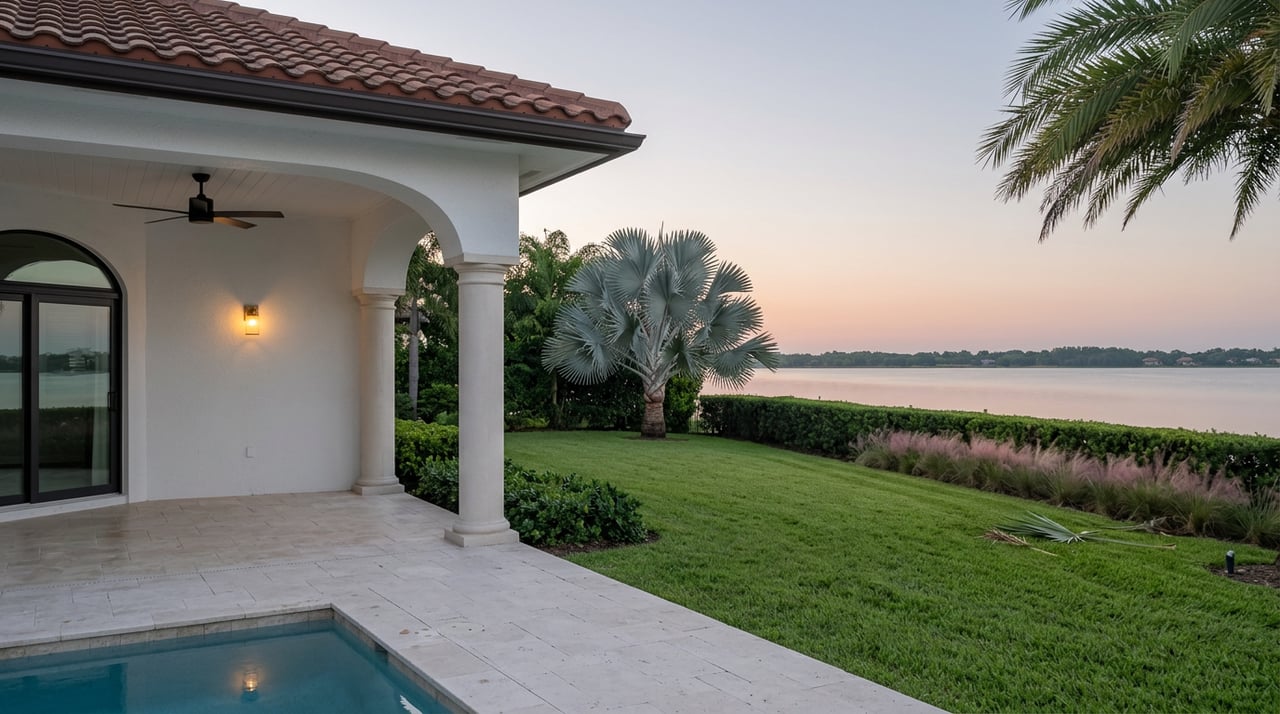
Every other waterfront community in this corner of Southwest Florida answers to the moon. Port Royal boat owners check the dockmaster's tide report before a low tide stalls them on a mud flat. Aqualane Shores residents watch NOAA charts before scheduling seawall work around a falling tide. Coquina Sands beachgoers pull up a tide app before deciding whether Lowdermilk has any sand left to sit on this afternoon. Miromar Lakes is the one gated community in the region where none of that applies, and residents who still plan their week around tidal math are solving a problem that does not exist here.
Lake Como is freshwater and man-made, which means it carries none of the maintenance calendar that comes with living on saltwater. No tide charts to check before a boat launch. No salt corrosion working through dock hardware and railings. No storm surge risk reshaping the beach overnight. The three miles of white-sand shoreline look the same on a Tuesday in August as they do on a Saturday in February, because nothing out there is waiting on the Gulf to decide what kind of day it's going to be.
That doesn't mean the week runs itself. It means the actual clock that governs life at Miromar Lakes isn't tidal at all. It's the club's own printed calendar, and it governs three separate restaurants, a signature golf course, a working marina, and a set of tennis courts that never once check what the tide is doing forty minutes west.
The Water That Doesn't Check a Chart
Lake Como spans roughly 700 contiguous acres, with depths ranging from 26 to 40 feet in parts of the lake, deep enough that it has served as a competition venue for U.S. Open Water swim trials and national-level events. Residents fish it too. The culture here leans catch-and-release, with largemouth bass and bluegill commonly caught near mangrove edges and private docks, which keeps the ecosystem intact rather than fished down season after season.
Boat access runs through the Marina on the Peninsula, which functions less like a rental counter and more like a concierge desk for anyone with a slip or a storage spot. Fuel, gated boat storage, and basic upkeep are handled on-site. Residents who don't own a boat still have a way onto the water: pontoons, sailboats, and kayaks are available through the marina for anyone who wants an afternoon on the lake without the overhead of owning the vessel.
None of this is unusual for a Florida waterfront community on its face. What's unusual is the absence of the maintenance calendar that normally comes with it. There's no seawall inspection tied to storm season, no dock hardware replaced early because salt got into the threads first. The freshwater setup trades the ocean view for a lower-maintenance version of the same lifestyle, which is a genuinely different proposition than anything else on this list of neighborhoods.
Three Restaurants, Three Different Clocks
The club runs three dining rooms, and each one operates on its own rhythm rather than competing for the same Friday night crowd.
| Room | Feel | Best For |
|---|---|---|
| Beach Clubhouse | Fine dining, indoors or under the stars, chef's nightly features | A slow evening, a wine pairing, an occasion worth booking ahead |
| Blue Water Beach Grill | Open-air pavilion on the beach, happy hour, live music, dancing | Sunset drinks, a casual dinner that doesn't require a reservation mindset |
| Golf Clubhouse Dining Room | Members-only, its own menu, tied to the golf calendar | Breakfast before a tee time, lunch after the round |
The Beach Clubhouse is where Chef Julien runs the kitchen, and it's built for the evenings people actually plan around, the wine dinners, the private dining room with its hand-carved table cut from a single tree trunk, the kind of night where a fireplace and a view of the lake matter as much as the food. The Blue Water Beach Grill sits at the other end of the spectrum entirely, an open-air pavilion built for the version of dinner that starts with a happy hour and doesn't have a hard stop, with music and dancing carrying the evening past the point where anyone's checking a clock. The Golf Clubhouse Dining Room, with its own separate menu under Chef Megian, exists on a different schedule altogether, one set by tee times rather than sunset.
Knowing which room fits which night is the actual skill here, and it's the same skill that governs the rest of the property. The calendar that matters isn't a weather forecast. It's which kitchen is running tonight and what it's built for.
Courts That Don't Skip a Beat
The Racquet Club keeps a full rotation running across its lighted Har-Tru courts, with a regular lineup of cardio tennis sessions, open clinics, and competitive round robins that fill the week regardless of season. Pickleball runs on its own active schedule of clinics and open play alongside it. None of it pauses for weather in the way that outdoor recreation on the coast routinely does, since the courts sit inland, away from the wind patterns and afternoon squalls that reroute beach plans on the Gulf side of the county.
The golf side runs on a similar logic. The course is the only Arthur Hills Signature design in Southwest Florida, recently remastered with new greens and fresh white-sand bunkers, and it's built to play the same way in October as it does in March. Six sets of tees stretch the layout from 4,500 to 7,100 yards, which means the challenge scales to the golfer rather than the golfer having to scale to a single fixed course, and that flexibility is part of why the club keeps its tee sheet full across a full calendar year instead of just a winter season.
A Garden Built for a Tuesday, Not a Showcase
Past the pool and the beach sits the Zen Garden, a quieter corner most people walk past without stopping. Its centerpiece is a sculpture called Dancing, by Swiss sculptor Housi Knecht, set among Chicago brick pavers and manicured plantings with benches meant for sitting rather than photographing. It leads into a small Sculpture Garden and from there to the community's own theater. None of it is built as a seasonal showpiece. It's built the way the rest of the club is built, for a resident walking through on an ordinary Tuesday, not a visitor passing through during peak season.
That's the through line across every part of this property. The three restaurants exist because different nights call for different rooms, not because the calendar swings between a busy season and a dead one. The courts and the golf course run on the same weekly rhythm in August that they do in January. Even the quiet garden corner was designed for daily use rather than a single dramatic season. Add it up and the community's own social calendar, which fills well past 300 events a year, starts to make sense as the actual organizing principle here. Miromar Lakes was never built around a tide. It was built around a resident who's here every week, and the schedule reflects that.
If you're weighing a move within Miromar Lakes, curious what your home is worth in today's market, or thinking through a purchase that fits this kind of week-to-week living, the team at Laurel McGarel Group knows this property from the inside. Schedule a private consultation and we'll walk through it with the same specificity we brought to this list.